The Biology Behind Food Noise
Introduction
Food noise is real. I describe it as the constant chitter-chatter between our stomach and our brain in between meals; like a constant stream of text messages asking us what we can eat next. For some people this noise can feel almost continuous, leaving them wrestling with will power and feeling out of control around food.
Everyone will experience this at varying degrees, with some people thinking about food all the time and others only feeling triggered in certain situations, rather than all the time.
In this post we discuss:
- What causes Food Noise
- How it differs from True Hunger
- The role of Leptin
- The importance of GLP-1 medications and how they can stop food noise
- Does food increase natural GLP-1, and how does this compare to GLP-1 medications?
- How satiety works in the body
What causes food noise?
Feeling hungry as time passes since your last meal is entirely normal: that’s natural appetite, your body doing exactly what it should in response to a genuine need for fuel. So, if you have skipped breakfast, grabbed a latte on the run, or simply haven’t eaten enough food to fuel your body, this is likely to increase your feelings of hunger. These feelings are what we call genuine hunger, and should be acted on as the body is seeking energy and nourishment.
Food noise isn’t quite the same as hunger and is not a medical term, but rather is a description given to persistent thoughts around our appetite and food. It is very rarely about a lack of discipline, and may just be our biological instincts kicking in alongside a mismatch with our modern food environment. Sometimes your body sends you the wrong messages, especially when it comes to food, leading to inappropriate appetite signalling. Here are some reasons that we might experience ‘food-noise’.
An unbalanced plate
Sometimes we can consume sufficient calories at a meal to meet our needs, but our meal may not have been balanced; we may have consumed too many carbohydrates in comparison to proteins, fibre, and healthy fats. Protein and Fibre are the dynamic duo when it comes to satiety. Eating triggers a satiety cascade in the body, but if our meal was lacking these basic building blocks, our satiety mechanisms can be disrupted (see more on this in a minute).
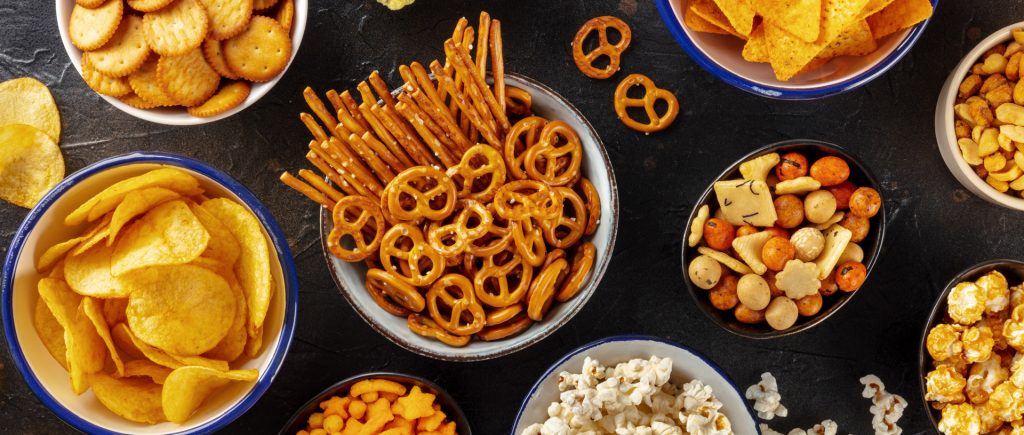
Eating foods that are quickly digested and broken down, such ultra processed foods (UPFs) or sugary treats, mean less work for our gut. This can confuse our satiety systems and trigger hunger again faster, leading to increased cravings between meals. This, in turn, can increase the amount of calories we eat over the course of a day as the body is not actually receiving what it is craving.
Our body does not store protein (apart from as part of our lean muscle mass), so it needs a constant supply of protein’s building blocks called amino acids. It is difficult to outsmart the human body, and it is likely to signal hunger if we are not meeting our macronutrient requirements.
In my nutrition clinics, I often see a correlation between skipping breakfast and greater food noise later in the day. While we might feel like we are winning the calorie game by skipping breakfast (and let’s face it when we are busy in the morning we might even forget about food altogether), in reality, the body is clocking this. Once the busyness of the day is over, appetite can return stronger and can lead to us overeating and snacking more in the evening. In effect, we are simply catching up on our daily energy needs, but often the foods we choose to eat (after we have tidied up the kitchen) tend to be more of the snack-like foods we mostly try to avoid.
I often see this ricochet into repeated behaviour: snacking in the evening having not eaten enough that day, creating guilt around food, followed by restriction the next morning to make up for it, and so the cycle continues.
False hunger: Blood sugar imbalance
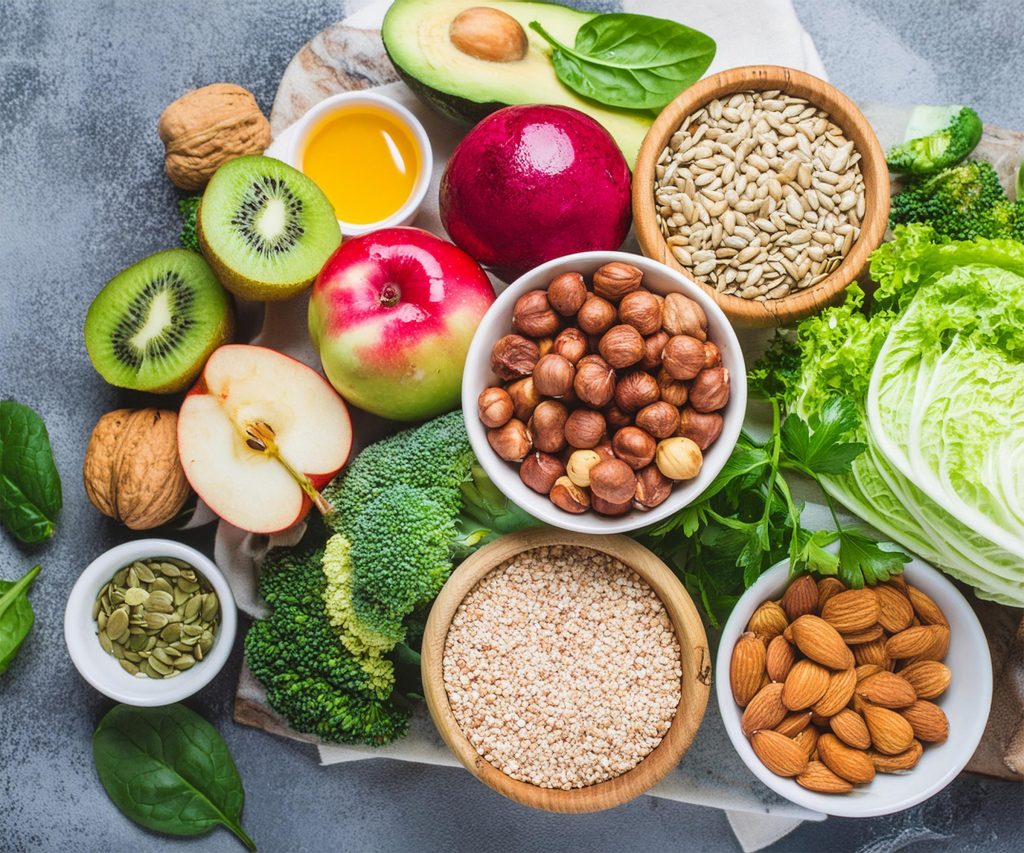
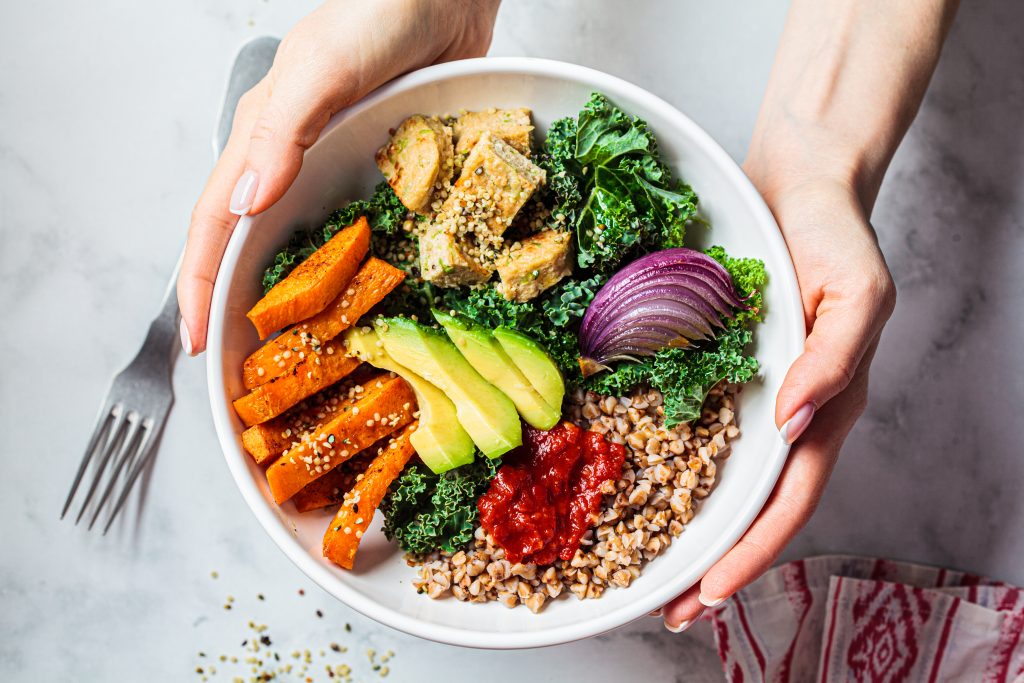
False hunger is, again, linked to eating unbalanced plates. When we eat a balanced plate, which contains around ¼ plate of protein, ½ a plate of mixed vegetables, ¼ plate of healthy whole food carbohydrates alongside healthy fats and maybe a piece of fruit, we are mostly giving our body the right foods in the right amounts to function as intended.
Whole food carbohydrates, such as bulgur wheat, seeded breads, sweet potatoes, oats, quinoa, freekeh, buckwheat as well as beans and lentils break down slowly, and create a steadier blood glucose level. Free sugars, on the other hand, which we find in fizzy drinks, fruit juice, as well as fast acting carbohydrates; such as breakfast cereals, snack bars, crisps, white bread, bakery products, biscuits, cakes and confectionery and many convenience foods behave differently in the body and affect our blood glucose levels more rapidly, causing sharper spikes and more pronounced crashes.
Bear in mind that blood glucose is meant to fluctuate. This is normal and happens to us all multiple times a day, so it is fine to eat some of these fast-acting foods in moderation, as the body will naturally regulate its own blood glucose levels and bring them back into a ‘normal’ range.
Problems only really arise when we eat too many fast-acting carbohydrates at a single meal, or when we eat too many high carbohydrate snacks in between. When this happens, our normal blood sugar patterns can start to spike and fall more erratically. We may not register a small drop in blood glucose, but the spikes and sudden crashes can trigger cravings (usually for even more fast-acting carbohydrates) in an attempt to quickly raise blood glucose back into a normal range.
If we are relying on foods such as cereal or toast and jam at breakfast, a sandwich with crisps and a soft drink at lunch, a chocolate bar mid-afternoon, and a ready meal for supper followed by another sweetened drink and a few crisps, we may notice that we feel hungrier throughout the day than if we ate just three balanced meals. This is because we raise and drop our blood sugar levels at more extreme levels – in a similar way to a roller-coaster. Appetite increases when our glucose levels drop down, usually this increases our total calorie consumption throughout the day; following this pattern regularly can lead to long-term weight gain.
Cravings that have nothing to do with hunger!
Hedonic hunger has very little to do with true hunger, and is linked to our brain chemistry, reward centres, and learned patterns. We may not feel hungry at all, but when we are faced with the smell of fresh bread, or we spot a delicious dessert on the menu, we may find ourselves tempted by the food, even though we are not physically hungry. This is sometimes referred to as the ‘dessert mentality’, and can be thought of as more of a mental craving than a physical craving.
What about Leptin?
This is where it gets interesting. Many people who are overweight or living with obesity have an imbalance when it comes to their satiety mechanisms and appetite.
Leptin is a hormone produced by our white adipose cells, and acts as a messenger that signals how much energy we have stored in order to regulate our appetite. As body fat increases, leptin levels rise, signalling to the hypothalamus that energy stores are sufficient and appetite can be suppressed. In a well-functioning system, this creates a natural feedback loop: more stored energy leads to reduced hunger, helping to keep body weight relatively stable over time.
Leptin resistance. Sometimes, this signalling system can break down. Despite having ample, or even abundant, circulating leptin, the brain no longer responds to it appropriately, so the message of ‘we have enough energy stored’ fails to register.
The results in a paradox: rather than curbing appetite, high leptin levels can lead to persistent hunger and reduced satiety. This can lead to acute hunger, even when we have eaten sufficient food and can be a driver in obesity.

What is GLP-1?
GLP-1 (Glucagon-like-peptide-1) is just one of the hormones made naturally in the body that increases satiety. It is the main component of many of the weight loss injections such as Ozempic®, Wegovy®, and Mounjaro®.
These medications work by mimicking the action of the natural hormone GLP-1 and GIP (glucose-dependent insulinotropic polypeptide), which help regulate appetite, normalise our blood sugar response, slow how quickly food leaves the stomach, and reduce appetite. This makes people feel fuller sooner while eating less.
Medications definitely have their place and can be life-changing for those that need them. They can support those with Type 2 diabetes as well as obesity, offering these people a better quality of life. For those where a diet approach has not been effective, these medications can be transformative.
However, in 2026, it has been estimated that around 5% of people in the UK are taking weight loss jabs, often without additional diet and lifestyle support. With reduced appetite while we are taking these medications, every mouthful counts to ensure that we are meeting our macronutrient and micronutrient requirements, and movement, more specifically, strength training becomes a vital element in maintaining our muscle mass while losing weight.
How do they differ from our natural hormones?
The GLP-1 in weight loss medications lasts longer in the body and has a much stronger effect on our appetite, lasting for days. This prescription GLP-1 has a half-life of around 5-7 days, meaning that it can take several weeks, even up to a month, before it completely breaks down and stops being effective.
The body has cells called L-cells in the ileum and colon, these produce their own GLP-1 in response to the food in our diet. Naturally produced GLP-1 has a half-life of only around 1–2 minutes in the body and is rapidly broken down by the enzyme DPP-4 (dipeptidyl peptidase-4). This means that we rely on smaller but more regular bursts of GLP-1 to control our appetite and keep us feeling full. Think of it a bit like a firework giving off small sparks of the hormone in short succession, with one spark being replaced by the next.
We cannot directly compare GLP-1 in weight loss injections and tablets and natural GLP-1, because they behave differently in the body and natural satiety occurs from a cascade of different effects, rather than relying on the action of ONE single hormone.
So can food increase our GLP-1?
Yes, but this is not the whole picture. When foods such as fibre, protein, fats, complex carbohydrates, and resistant starch reach the L-cells found in the lower part of our small intestine and colon, these cells release GLP-1.
In contrast; if we are eating a diet rich in processed foods or foods that are digested and absorbed quickly, these foods may not trigger sufficient GLP-1 to signal satiety. Although we can produce some GLP-1 higher in the gut, we also rely on the residue or remnants of food from our diet to trigger its release further down the digestive tract.
So GLP-1 is important for satiety, but it is just part of the picture.
How satiety REALLY works (hint: it is more than just GLP-1)
When we eat in a way that supports our natural biology, we can start to influence our own hunger cues, rather than fighting them. So rather than a battle of willpower, we can put ourselves in the driving seat of our appetite, without deprivation.
The stomach and the STRETCH response
Healthy whole foods are generally bulky. Protein and fibre rich foods, like fruits, vegetables, beans, lentils, and wholegrains all take up space on our plate and space in our stomach. Stretch receptors on the stomach wall respond by sending a message to the brain that we have had enough to eat.
Because protein stays in the stomach for longer, and fibre slows down gastric emptying, our stretch receptors stay active for longer. This means that a chicken and vegetable stir fry with noodles is likely to fill us up longer than a ham sandwich. This explains why foods that pass through the digestive tract faster such as cornflakes, biscuits, or sweetened drinks are less likely to fill us up longer term.
When the stomach is stretched and gastric emptying delayed, this also delays the release of a hormone called ghrelin. Ghrelin is a hormone that increases our hunger and desire to eat food and its suppression is another way in which the stomach can influence appetite. Both of these mechanisms work in tandem.
Your small intestine is a mini-laboratory!
Next is the small intestine. In the upper small intestine we have nutrient sensing receptors like mini laboratories that respond to the protein, fats, and carbohydrates in our diet. These signals trigger the release of hormones, including cholecystokinin (CCK), which plays a key role in early satiety. Messages are sent to the brain via the vagus nerve, which mainly carries information from the gut to the brain and helps regulate appetite in real time.
We also have cells called K-cells in our upper small intestine (more specifically the duodenum and upper jejunum) that support the CCK with GIP (which as you might remember is the other hormone present in Mounjaro®, working alongside GLP-1).
The deep satiety that reduces food noise
The L-cells (also known as specialised endocrine cells) we mentioned earlier only make up a fraction of the cells lining our gut, but play a key role in satiety. As we have seen, these cells pump out small bursts of GLP-1, but they also produce another hormone called PYY or Peptide YY.
PYY works by slowing gastric emptying and signalling fullness to the brain, reducing appetite in a similar way to GLP-1. It acts primarily through Y2 receptors in the hypothalamus, where it inhibits the neurons that normally drive hunger. Effectively, this works as an opposite counterpart to GLP-1, switching OFF the signal to ‘go and eat food’, rather than switching ON a signal to stop eating.
Both hormones have a short lifespan and depend on a constant stream of release to sustain their effect. These 2 hormones hold the key to longer term satiety and are one of the main reasons we might feel full 2–4 hours after a meal, and why they play such a crucial role in long-term appetite control.
Since many people start to feel hungry again after just a couple of hours, making sure that these deeper satiety mechanisms are working optimally is key to helping us manage our appetite better between meals. Again, we need to apply a degree of nuance, as some GLP-1 is produced shortly after we consume food, which may be related to neural signalling, rather than the food itself – which may indicate a 2-phase release of GLP-1, however mechanistically, the more natural and unrefined the diet, the more GLP-1 is likely to be released by the gut.
Switching ON all of these signals can improve appetite and weight control in many people. However, in leptin resistance, the effects may be less pronounced.
So, are GLP-1 Medications the answer for food noise?
Not completely. If we only have a small amount of weight to lose, it is always best to try a diet and lifestyle switch first. This is because we learn how best to switch on our natural satiety while eating a balanced diet and increasing movement. This natural approach avoids reliance on medications and the weight gain yo-yo effect when we come off them. In this sense, changes in our diet and lifestyle can support our health better in the long term. This can work well in individuals where appetite signalling can be postively modulated through diet.
Medication can be a stepping stone for those living with obesity, helping to move the dial on the scales quickly. This can be particularly important when weight gain is contributing to other health factors such as high blood pressure, diabetes, or increased levels of inflammation.
If we can learn real-life measures to feel healthier and fuller for longer, we’re more likely to keep some of these changes in everyday life, even once we’ve reached our weight loss goal.
Many people don’t stay on weight loss medications long-term; discontinuation rates within the first year are substantial, and stopping is often followed by a high degree of weight re-gain.
Without diet and exercise interventions, weight loss can lead to loss in lean muscle mass alongside body fat, while re-gained weight tends to be predominantly body fat. This leaves us with a less favourable body composition longer term, even when we are at a similar overall weight. This tends to be the case with weight loss programmes that do not cover protein requirements adequately and where diet management is critical. A carefully constructed nutrition approach can help to prevent this.
Although figures vary, it is thought that up to 20% of people who take weight loss medications stop taking these due to ineffectiveness or due to unwanted side effects, making approaches that use a food first approach a vital intervention for many.
Reduced appetite can mean reduced nutrients
From my experience in clinic, many people taking weight loss medications can struggle to meet their daily nutrient requirements. The result of this can be slow and subtle, but can lead to sub-optimal intkae of certain nutrients over time. The most documented nutrient deficiencies are thought to be proteins, omega 3 fatty acids, calcium, iron, iodine, and certain B vitamins.
On a parting note: while weight loss medications can be effective, for many people the reduced enjoyment of food is a real and often underdiscussed issue. This is one of the key reasons I work with as many of my clients as possible to try a properly balanced, food-first approach where possible.
What does a food first approach look like?
If you have less than 2 stone (12 kg) to lose, a food first approach first approach is a great starting point. You may wish to try a purposefully designed nutrition and weight loss programme before embarking on medications. Always follow your Doctor’s advice to find out which approach might be right for you.
A food first approach would have you following a structured plan to target excess weight in a completely natural way. There are lots of dedicated weight loss programmes available by many different nutritionists to support this approach.
The key with any weight loss programme is to support our nutrient requirements with foods that are satiating and healthy and should have a good strategy for turning the programme into a healthy ‘forever’ way of eating after the initial weight loss phase.
A good weight loss programme is not simply about a calorie deficit, but should be a nutritionist approved programme that supports all areas of our health simultaneously, rather than being based on just a calorie deficit. As we have discussed here, in order for weight loss programme to succeed, we need to feel both nourished and satiated.
If you want to start your journey with a food first approach.
My advice would always be to remain neutral and to choose a programme where you feel that your unique needs are being met. While I do offer a programme, I still want you to choose the right plan for you, where you feel most comfortable. Also choose a time that suits you the best. Starting a weight loss journey when your life is busy (a new job, a house move, or an imminent holiday can really hamper your chances of success.)
Renew Reset Recharge®
In my 20 years of clinical practice, I created a dedicated weight loss plan called Renew Reset Recharge® which offers a straightforward, guided, science-led programme, to form sensible, no nonsense habits that last a lifetime.
This programme takes place each month with small groups and includes 4 live group Zoom calls with Dominique Ludwig.
Participants report an average of 3-4 kg (6-9lb) in 28 days, with an 80% reduction in cravings and food noise.
A brief overview of Renew Reset Recharge® 28 day Programme
- It is a science led nutrition programme to transform your health and change the way you eat forever.
- It fits easily into everyday and family life.
- It intuitively becomes a way of eating for the rest of your life; no restriction, just a handful of principles that work.
- It’s like a magic key to your metabolism, you will learn how to lose weight easily and maintain your weight effortlessly.
- It is based on simple principles that you can use anywhere – no number crunching / no calculations
- Our finishers survey shows that around 80% of people experience less cravings on the programme. Many people also experience improvement to energy, mood and sleep; better digestion with less bloating and over 20% notice a reduction in pain and inflammation.
- RRR reframes your relationship with food and take the STRESS out of eating
- It is fantastic as a stand-alone programme to lose weight and reset. You will be in a GROUP which develops a sense of community during your journey AND you will have the chance to talk with Dominique in weekly group ZOOM calls where you can ask all your questions to help you stay on track.
- RRR comes with the FREE follow-on programme called Triple 30 to make sure you feel supported throughout and beyond.
Become your own nutrition expert in 28 days, and be in control for the rest of your life: no food noise, no cravings, no guilt.
We offer a FREE three day sample of Renew Reset Recharge® so you have the chance to see if this is a compatible programme for you before committing.
Disclaimer
Features published by Dominique Ludwig are not intended to treat, diagnose, cure or prevent any disease. Always seek the advice of your GP or another qualified healthcare provider for any questions you have regarding a medical condition, and before undertaking any diet, exercise or other health-related programme. Please refer to our Terms and Conditions and Medical Disclaimer for more information as well as our Website Terms and Conditions.
References
Kohanmoo, A., Faghih, S. & Akhlaghi, M., 2020. Effect of short- and long-term protein consumption on appetite and appetite-regulating gastrointestinal hormones, a systematic review and meta analysis of randomized controlled trials. Physiology & Behavior, 226, p.113123. doi:10.1016/j.physbeh.2020.113123
Koliaki, C., Kokkinos, A., Tentolouris, N. & Katsilambros, N., 2010. The effect of ingested macronutrients on postprandial ghrelin response: a critical review of existing literature data. International Journal of Peptides, 2010, Article ID 710852, 9 pp. doi:10.1155/2010/710852.
Batterham, R.L., Heffron, H., Kapoor, S., Chivers, J.E., Chandarana, K., Herzog, H., le Roux, C.W., Thomas, E.L., Bell, J.D. & Withers, D.J., 2006. Critical role for peptide YY in protein-mediated satiation and body-weight regulation. Cell Metabolism, 4(3), pp.223–233. doi:10.1016/j.cmet.2006.08.001
Karra, E. & Batterham, R.L., 2009. The role of peptide YY in appetite regulation and obesity. Journal of Physiology, 587(1), pp.19–25. doi:10.1113/jphysiol.2008.164269.
Dagbasi, A., Frost, G., et al., 2024. Diet shapes the metabolite profile in the intact human ileum which impacts PYY release. Science Translational Medicine, 19 June. Available at: https://www.science.org/doi/10.1126/scitranslmed.abc1234
Naumann, S., Schweiggert-Weisz, U., Eglmeier, J., Haller, D. and Eisner, P. (2019) ‘In vitro interactions of dietary fibre enriched food ingredients with primary and secondary bile acids’, Nutrients, 11(6), 1424. https://doi.org/10.3390/nu11061424
Kwa, M., Plottel, C.S., Blaser, M.J. and Adlercreutz, H. (2016) ‘The intestinal microbiome and estrogen receptor–positive female breast cancer’, Journal of the National Cancer Institute, 108(8), djw029.